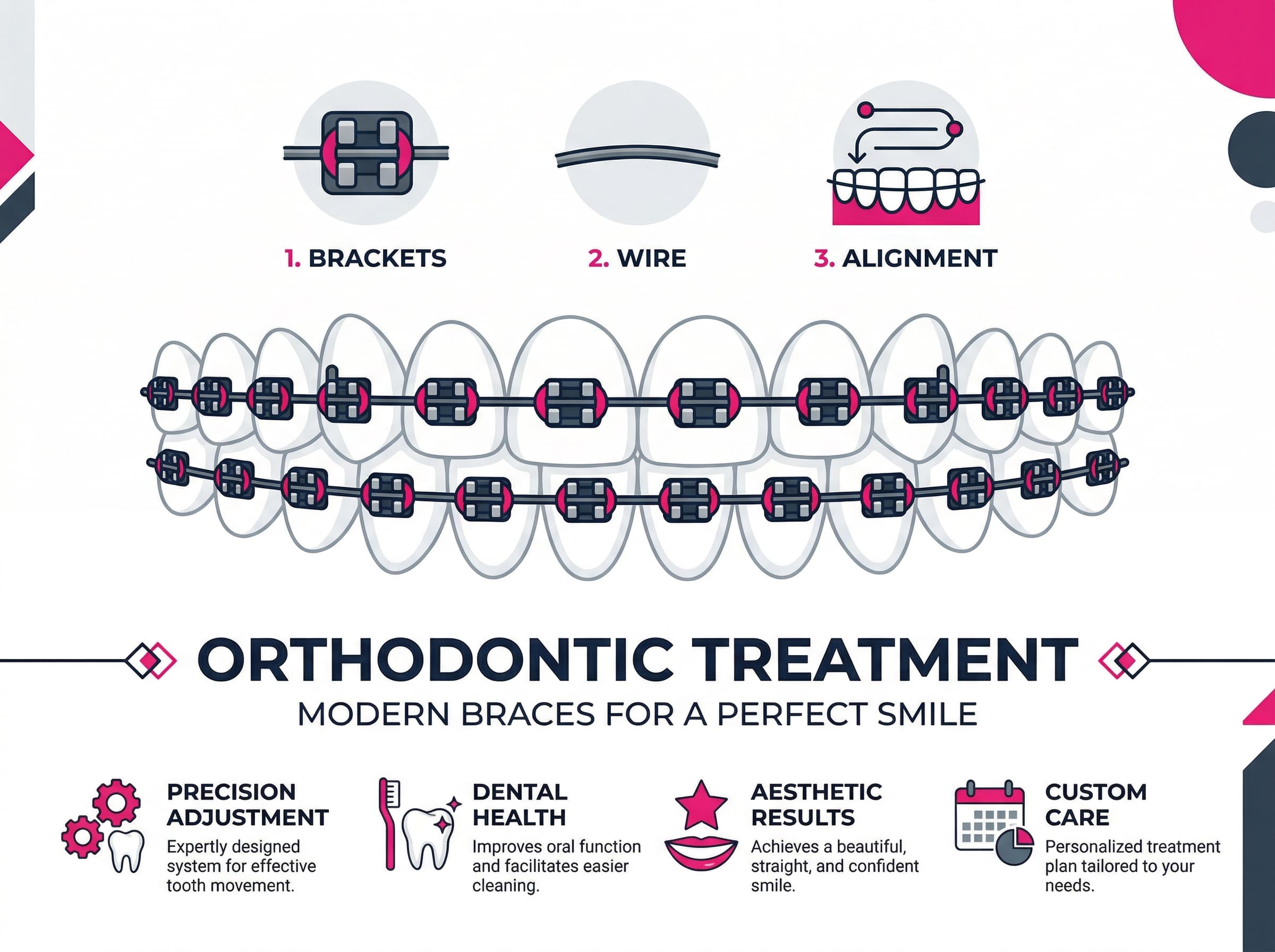
Braces or clear aligners in Nepal: cost, duration, and who each suits
Both straighten teeth. They differ in price, treatment time, visibility, and how much of the result depends on you remembering to wear them.
Dr. Niyukty ArjalMDS Periodontist, Gums & Giggles Dental Clinic·
Patients usually arrive having already decided they want aligners, mostly because they are invisible. That is a reasonable preference, but it is only one of five factors worth weighing, and for some bites it is the wrong choice entirely.
Here is the honest comparison, including the parts that rarely make it into an advertisement.
Cost
Fixed braces at our clinic start from NPR 70,000, with the final figure depending on the bracket type and how long treatment runs. Metal brackets sit at the lower end, ceramic and self-ligating systems above them.
Clear aligners are typically more expensive than metal braces for equivalent cases, because the cost includes digital planning and a full series of custom-made trays. Ask for the total treatment cost rather than a per-tray price, and confirm whether refinements and retainers are included.
Treatment time
For comparable crowding, treatment times are broadly similar: often 12 to 24 months, sometimes longer for complex bites. The difference is what controls that timeline.
Braces work continuously, whether you think about them or not. Aligners work only while they are in your mouth, and they need 20 to 22 hours a day. A patient who takes them out for long lunches will add months to their own treatment, and that is the most common reason aligner cases run late.
What each handles well
Aligners are excellent for mild to moderate crowding, spacing, and relapse after previous orthodontic treatment. They are less predictable for large rotations, significant bite corrections, and cases that need teeth moved bodily rather than tipped.
Fixed braces handle essentially the full range, including the complex bite corrections aligners struggle with. That versatility is why they remain the default for difficult cases.
Mild crowding or spacing: either works
Rotated canines, significant bite correction: braces usually
Relapse after old braces: aligners often ideal
Teenagers who will not comply: braces, firmly
Daily life
With braces you avoid hard and sticky food for the duration, cleaning takes longer, and there are a few days of soreness after each adjustment. They are visible, though ceramic brackets are considerably less so.
With aligners you remove them to eat, so there are no food restrictions, and cleaning your teeth is unchanged. You will need to take them out before every meal and every drink other than water, brush before putting them back in, and carry a case. Some people find this trivial and some find it exhausting.
Gum health, which decides whether you start at all
This is the part that matters most in a periodontal practice. Moving teeth through inflamed gums and reduced bone is a genuinely bad idea. Orthodontic force applied to a periodontally compromised tooth can accelerate the damage.
Before either treatment, gums should be examined, charted, and treated if disease is present. Where bone support is already reduced, orthodontics may still be possible, but the plan has to account for it and the maintenance schedule tightens during treatment.
Aligners have one small advantage here: being removable, they make cleaning easier during treatment, which matters for patients with a gum disease history. Braces make cleaning harder precisely when it needs to be better.
Retention: the part everyone underestimates
Teeth drift back. This is not a failure of treatment, it is simply how the tissues behave, and it applies equally to braces and aligners.
Whichever you choose, budget for retainers and plan to wear them long-term, typically nightly after an initial full-time period. A treatment plan that does not include retention is not finished.
How to decide
Book an assessment and ask three questions: is my case treatable with aligners, what is the total cost for each option including retainers, and how does my gum condition affect the plan.
The answer often makes itself obvious. A straightforward crowding case in a disciplined adult is a good aligner case. A complex bite, or a teenager, or anyone honest enough to admit they will not wear trays for 22 hours a day, is better served by braces.
Written by Dr. Niyukty Arjal, MDS Periodontist, Gums & Giggles Dental Clinic. This article is general information about dental health and is not a diagnosis. Symptoms vary between patients, so book an examination for advice specific to your own teeth and gums.
Keep reading
Gum care · 7 min read
The four stages of gum disease, and what each one costs to treat
Gum disease is painless for most of its course, which is why it is usually found late. Here is how it progresses, what treatment each stage needs, and where the cost rises steeply.
Why your gums bleed when you brush, and what it actually means
Bleeding gums are the single most common thing patients mention and the single most common thing they ignore. Seven causes a periodontist sees weekly, and what to do about each.